---
title: Closing the Solar Farm Monitoring Gap with LoRa® Technology
description: Wired sensors can't scale past 500MW. Learn how LoRa solar farm monitoring gives OEMs full-fleet visibility into trackers, inverters and cleaning robots.
image: https://blog.semtech.com/hubfs/LoRa-BLOG-Closing%20the%20Solar%20Farm%20Monitoring%20Gap-Banner-1400x600-1.jpg
---
[Skip to main content](https://blog.semtech.com/closing-the-solar-farm-monitoring-gap-with-lora-technology-1#content)
- [Cross Reference](https://www.semtech.com/design-support/cross-reference-search)
- [Parametric](https://www.semtech.com/design-support/parametric-search)
- [Shop](https://www.semtech.com/shop)
- [Investors](https://investors.semtech.com/)
- [mySemtech](https://semtech.my.site.com/DP/)
- EN
- [EN](https://www.semtech.com/)
- [CN (中文)](https://www.semtech.cn/)
- [JP (日本語)](https://www.semtech.jp/)
- [FR](https://www.semtech.fr/)
[](https://www.semtech.com)
- [LoRa®](https://www.semtech.com/lora)
- [LoRa® Overview](https://www.semtech.com/lora)
### LoRa Overview
LoRa is the de facto wireless platform of Internet of Things (IoT). Semtech's LoRa chipsets connect sensors to the Cloud and enable real-time communication of data and analytics that can be utilized to enhance efficiency and productivity.
[Read More](https://www.semtech.com/lora)
- [LoRa (PHY)](https://www.semtech.com/lora/what-is-lora)
- [Benefits of LoRa](https://www.semtech.com/lora/why-lora)
- [LoRaWAN® Standard](https://www.semtech.com/lora/lorawan-standard)
- [Products](https://www.semtech.com/products/wireless-rf)
- [Applications](https://www.semtech.com/lora/lora-applications)
### Applications Overview
With an ever-increasing number of IoT vertical applications, LoRa devices and the LoRaWAN standard is creating business efficiencies and improving lives around the world.
[Read More](https://www.semtech.com/lora/lora-applications)
- [Agriculture](https://www.semtech.com/lora/lora-applications/smart-agriculture)
- [Cities](https://www.semtech.com/lora/lora-applications/smart-cities)
- [Environment](https://www.semtech.com/lora/lora-applications/smart-environment)
- [Healthcare](https://www.semtech.com/lora/lora-applications/smart-healthcare)
- [Buildings](https://www.semtech.com/lora/lora-applications/smart-buildings)
- [Homes](https://www.semtech.com/lora/lora-applications/smart-homes)
- [Industrial Control](https://www.semtech.com/lora/lora-applications/smart-industrial-control)
- [Retail](https://www.semtech.com/lora/lora-applications/smart-retail)
- [Supply Chain and Logistics](https://www.semtech.com/lora/lora-applications/smart-supply-chain-logistics)
- [Electricity](https://www.semtech.com/lora/lora-applications/smart-electricity-metering)
- [Gas](https://www.semtech.com/lora/lora-applications/smart-gas-metering)
- [Water](https://www.semtech.com/lora/lora-applications/smart-water-metering)
- [Ecosystem](https://www.semtech.com/lora/ecosystem)
### Ecosystem Overview
LoRa is bolstered by a diverse global ecosystem of hardware manufacturers, software designers, network providers, and industry associations.
[Read More](https://www.semtech.com/lora/ecosystem)
- [LoRa Alliance®](https://www.semtech.com/lora/ecosystem/lora-alliance)
- [Featured Sensor Use Cases](https://www.semtech.com/lora/ecosystem/sensor-features)
- [Gateways](https://www.semtech.com/lora/ecosystem/gateways)
- [Software](https://www.semtech.com/lora/ecosystem/software)
- [Networks](https://www.semtech.com/lora/ecosystem/networks)
- [Industry Alliances](https://www.semtech.com/lora/ecosystem/industry-alliances)
- [Resources](https://www.semtech.com/lora/resources)
### Resources Overview
Explore our top resources to help you learn more about LoRa devices and the LoRaWAN standard or bring a LoRa-based solution to market.
[Read More](https://www.semtech.com/lora/resources)
- [LoRa Products Overview](https://www.semtech.com/lora/resources)
- [Videos](https://www.semtech.com/lora/resources/lora-videos)
- [White Papers & Use Cases](https://www.semtech.com/lora/resources/lora-white-papers)
- [LoRa Developers & Tech Support](https://www.semtech.com/lora/resources/lora-community)
- [LoRa Calculator](https://www.semtech.com/design-support/lora-calculator)
- [Amazon Sidewalk](https://info.semtech.com/sidewalk)
- [Academy for LoRaWAN](https://www.semtech.com/lora/resources/lorawan-academy)
- [Logo Use](https://www.semtech.com/company/brand-resources)
- [Press Releases](https://www.semtech.com/company/press/category/pr-lora-wireless-rf)
- [Press Coverage](https://www.semtech.com/company/news/category/pr-lora-wireless-rf)
- [Contact](https://www.semtech.com/company/contact/support)
- [Products](https://www.semtech.com/products)
- [Products Overview](https://www.semtech.com/products)
### Products Overview
Thousands of customers worldwide rely on our diverse product portfolio and world class technology roadmap for solutions in low power wireless communications, optical data transport, video broadcasting, power management, circuit protection, touch sensing, and more.
[Read More](https://www.semtech.com/products)
### Quick Links
- [Product Selector Guides](https://www.semtech.com/design-support/product-guides)
- [Shop](https://www.semtech.com/shop)
- [Parametric Search](https://www.semtech.com/design-support/parametric-search)
- [LoRa® Wireless RF](https://www.semtech.com/products/wireless-rf)
### Products Overview
LoRa®, a long range, low power platform, and the de facto wireless platform of Internet of Things, is highly integrated and cost-effective, boasting a notable battery life of up to 20 years, a 3-mile range in urban environments and a 30-mile range outdoors.
[Read More](https://www.semtech.com/products/wireless-rf)
- [ICs for Gateways](https://www.semtech.com/products/wireless-rf/lora-core)
- [ICs for Sensors](https://www.semtech.com/products/wireless-rf/lora-connect)
- [LoRa Cloud™](https://loracloud.com)
- [Software Library](https://www.semtech.com/products/wireless-rf/software-library-protocol-solution)
- [Circuit Protection](https://www.semtech.com/products/circuit-protection)
### Products Overview
Sophisticated devices that protect sensitive circuitry from Electrostatic Discharge (ESD), Electrical Fast Transients (EFT), Cable Discharge Events (CDE), and other electrical overstress.
[Read More](https://www.semtech.com/products/circuit-protection)
### Circuit Protection Products
- [ESD Protection Diodes](https://www.semtech.com/products/circuit-protection/esd-protection)
- [TVS Diodes](https://www.semtech.com/products/circuit-protection/tvs-diodes)
### Interfaces
- [Antenna](https://www.semtech.com/products/circuit-protection/antenna)
- [Automotive Ethernet](https://www.semtech.com/products/circuit-protection/automotive-ethernet)
- [Automotive High Speed](https://www.semtech.com/products/circuit-protection/automotive-high-speed)
- [Ethernet](https://www.semtech.com/products/circuit-protection/ethernet)
- [HDMI](https://www.semtech.com/products/circuit-protection/hdmi)
- [RS-485](https://www.semtech.com/products/circuit-protection/rs485)
- [USB](https://www.semtech.com/products/circuit-protection/usb)
- [VBUS](https://www.semtech.com/products/circuit-protection/vbus)
- [Signal Integrity](https://www.semtech.com/products/signal-integrity)
### Products Overview
A comprehensive portfolio of innovative optical, analog and mixed-signal semiconductor solutions that serve the rising global demand for high-speed data transmission products.
[Read More](https://www.semtech.com/products/signal-integrity)
- [Clock & Data Recovery](https://www.semtech.com/products/signal-integrity/clock-and-data-recovery)
- [Laser Drivers and Transceivers](https://www.semtech.com/products/signal-integrity/laser-drivers-transceivers)
- [Limiting Amplifiers](https://www.semtech.com/products/signal-integrity/limiting-amplifiers)
- [ROSAs](https://www.semtech.com/products/signal-integrity/rosas)
- [Signal Conditioners](https://www.semtech.com/products/signal-integrity/signal-conditioners)
- [Transimpedance Amplifiers](https://www.semtech.com/products/signal-integrity/transimpedance-amplifiers)
- [Professional AV](https://www.semtech.com/products/professional-av)
### Products Overview
Advanced off-the-shelf technology that enables end-to-end systems and integrates advanced inline signal processing capabilities such as light compression, broadcast quality scaling and audio down-mixing.
[Read More](https://www.semtech.com/products/professional-av)
- [BlueRiver®](https://www.semtech.com/products/professional-av/blueriver)
- [USB Extension](https://www.semtech.com/products/professional-av/usb-extension)
- [PerSe® Smart Sensing](https://www.semtech.com/products/perse-smart-sensing)
### Products Overview
Ultra-low power, feature-rich touch controllers that are optimized for numerous applications and provide best-in-class sensitivity with robust noise immunity to enhance touch and near range proximity detection.
[Read More](https://www.semtech.com/products/perse-smart-sensing)
- [PerSe® Connect](https://www.semtech.com/products/perse-smart-sensing/perse-connect)
- [PerSe® Contact](https://www.semtech.com/products/perse-smart-sensing/perse-contact-human-sensor)
- [PerSe® Control](https://www.semtech.com/products/perse-smart-sensing/perse-control-touch-proximity-sensor)
- [IO Expanders](https://www.semtech.com/products/perse-smart-sensing/io-expanders)
- [Broadcast Video](https://www.semtech.com/products/broadcast-video)
### Products Overview
Award-winning solutions designed specifically to push real-world broadcast boundaries in performance, reach, power, and signal integrity while reducing time to market and design risks.
[Read More](https://www.semtech.com/products/broadcast-video)
- [AV Interface & Protocol Conversion](https://www.semtech.com/products/broadcast-video/av-interface-protocol-conversion)
- [Configurable EQ/CD](https://www.semtech.com/products/broadcast-video/configurable-eq-cd)
- [Cable Drivers](https://www.semtech.com/products/broadcast-video/cable-drivers)
- [Cable Equalizers](https://www.semtech.com/products/broadcast-video/cable-equalizers)
- [Crosspoints](https://www.semtech.com/products/broadcast-video/crosspoints)
- [Receivers (Deserializers)](https://www.semtech.com/products/broadcast-video/receivers-deserializers)
- [Reclocking](https://www.semtech.com/products/broadcast-video/reclocking)
- [Transmitters (Serializers)](https://www.semtech.com/products/broadcast-video/transmitters-serializers)
- [Power Management](https://www.semtech.com/products/power-management)
### Products Overview
A pioneer in power management ICs across networking and industrial power, handheld power and automotive applications, Semtech leads the quest to enable a new class of greener, smarter and smaller end products.
[Read More](https://www.semtech.com/products/power-management)
- [EcoBrite LED Drivers](https://www.semtech.com/products/power-management/ecobrite-led-drivers)
- [EcoSpeed DC-DC Converters](https://www.semtech.com/products/power-management/ecospeed-dc-dc-converters)
- [FemtoBuck DC-DC Regulators and Controllers](https://www.semtech.com/products/power-management/femtobuck-dc-dc-regulators-controllers)
- [FemtoSwitch Load Switch ICs](https://www.semtech.com/products/power-management/femtoswitch-switches)
- [nanoSmart LDOs](https://www.semtech.com/products/power-management/nanosmart-ldos)
- [Neo-Iso Solid State Relays](https://www.semtech.com/products/power-management/neo-iso-solid-state-relays)
- [Special Functions](https://www.semtech.com/products/power-management/special-functions)
- [Cellular IoT Solutions](https://www.semtech.com/products/cellular-iot-solutions)
### Products Overview
Leading edge-to-Cloud solutions delivering the device, software and connectivity services needed to simplify and accelerate data-driven transformation with cellular IoT.
[Read More](https://www.semtech.com/products/cellular-iot-solutions)
- [Managed Connectivity](https://www.semtech.com/products/cellular-iot-solutions/managed-connectivity)
- [Modules](https://www.semtech.com/products/cellular-iot-solutions/modules)
- [Router Solutions](https://www.semtech.com/products/cellular-iot-solutions/router-solutions)
- [Technology](https://www.semtech.com/technology)
- [Technology Overview](https://www.semtech.com/technology)
### Technology Overview
Our highly differentiated, disruptive analog and mixed-signal semiconductors and advanced algorithms enable today's most innovative electronics within some of the fastest growing verticals and markets.
[Read More](https://www.semtech.com/technology)
### Quick Links
- [Related Applications](https://www.semtech.com/applications)
- [LoRa White Papers & Infographics](https://www.semtech.com/lora/resources/lora-white-papers)
- [Product Selector Guides](https://www.semtech.com/design-support/product-guides)
- [LoRa® Wireless RF For The IoT](https://www.semtech.com/lora)
### LoRa Wireless RF For The IoT Overview
LoRa is the de facto wireless platform of Internet of Things (IoT). Semtech's LoRa chipsets connect sensors to the Cloud and enable real-time communication of data and analytics that can be utilized to enhance efficiency and productivity.
[Read More](https://www.semtech.com/lora)
- [LoRa (PHY)](https://www.semtech.com/lora/what-is-lora)
- [Benefits of LoRa](https://www.semtech.com/lora/why-lora)
- [LoRaWAN® Standard](https://www.semtech.com/lora/lorawan-standard)
- [PerSe® Smart Sensing](https://www.semtech.com/technology/perse)
### PerSe® Smart Sensing Overview
Semtech's PerSe technology intelligently senses human presence for optimized connectivity and enhanced user experience.
[Read More](https://www.semtech.com/technology/perse)
### Quick Links
- [Infographic](https://info.semtech.com/perse-smart-sensing-infographic)
- [Brochure](https://www.semtech.com/uploads/common/PerSe_One_Pager.pdf)
- [Blogs](https://blog.semtech.com/topic/perse)
- [Products](https://www.semtech.com/products/perse-smart-sensing)
- [Tri-Edge™ PAM4 CDR](https://www.semtech.com/technology/tri-edge)
### Tri-Edge PAM4 CDR Overview
Tri-Edge is a CDR platform optimized for PAM4 optical interconnect in next-generation 200G and 400G data center module and AOC applications.
[Read More](https://www.semtech.com/technology/tri-edge)
### Quick Links
- [Tri-Edge White Paper](https://info.semtech.com/en/tri-edge-white-paper)
- [Product Selector Guide](https://www.semtech.com/uploads/design-support/Semtech_Optical_Product_Guide.pdf)
- [Open Eye MSA](https://www.openeye-msa.org/)
- [BlueRiver Platform For SDVoE™](https://www.semtech.com/technology/blueriver)
### BlueRiver Platform For SDVoE™
BlueRiver AV-over-IP chipsets are the world’s only chipsets to transport uncompressed, zero-latency Ultra HD/4K HDR over standard Ethernet and are the foundation for Software Defined Video Over Ethernet (SDVoE) technology.
[Read More](https://www.semtech.com/technology/blueriver)
- [BlueRiver OVERVIEW](https://www.semtech.com/technology/blueriver)
- [BlueRiver APPLICATIONS](https://www.semtech.com/technology/blueriver-applications)
- [BlueRiver VERTICAL MARKETS](https://www.semtech.com/technology/blueriver-vertical-markets)
- [SDVoE ALLIANCE®](https://www.semtech.com/technology/blueriver-sdvoe)
- [Circuit Protection](https://www.semtech.com/technology/esd-protection)
### Circuit Protection Overview
Semtech is leading the way in Transient Voltage Suppression (TVS) protection solutions that safeguard electronics systems against damage or latch-up caused by electrostatic discharge (ESD), lightning (surge), and other destructive voltage transients.
[Read More](https://www.semtech.com/technology/esd-protection)
- [Circuit Protection Overview](https://www.semtech.com/technology/esd-protection)
- [Z-Platform](https://www.semtech.com/technology/z-platform)
- [Design Resources](https://www.semtech.com/design-support/)
- [Design Resources Overview](https://www.semtech.com/design-support/)
### Design Resources Overview
Semtech places a high importance on delivering superior design support and provides a wealth of tools and resources with the goal of shortening your time to revenue for your new product introductions.
[Read More](https://www.semtech.com/design-support/)
- [Product Guides](https://www.semtech.com/design-support/product-guides)
- [Development Support Documentation](https://www.semtech.com/design-support/development-support-documents/)
- [Parametric Search](https://www.semtech.com/design-support/parametric-search)
- [Quality Assurance](https://www.semtech.com/quality/search-pb-lead-free-rohs-green)
- [LoRa GitHub](https://github.com/LoRa-Net)
- [LoRa PCB Design Review](https://info.semtech.com/pcb-design-review-service)
- [LoRa Calculator](https://www.semtech.com/design-support/lora-calculator)
- [LoRaWAN Academy and Training](https://learn.semtech.com/)
- [Product Cross Reference Search](https://www.semtech.com/design-support/cross-reference-search)
- [Frequently Asked Questions](https://www.semtech.com/design-support/faq)
- [mySemtech Document Portal](https://semtech.my.site.com/DP/)
- [IoT Applications](https://www.semtech.com/applications)
### Internet of Things
Award-winning LoRa Technology, ESD and surge protection, and smart control platforms for Internet of Things-enabled devices and low power, wide area network (LPWAN) infrastructure.
[Read More](https://www.semtech.com/applications)
- - [Smart Agriculture](https://www.semtech.com/applications/internet-of-things/smart-agriculture)
- [Smart Buildings](https://www.semtech.com/applications/internet-of-things/smart-building-automation)
- [Smart Cities](https://www.semtech.com/applications/internet-of-things/smart-cities)
- [Smart Emergency](https://www.semtech.com/applications/internet-of-things/smart-emergency-response)
- [Smart Environment](https://www.semtech.com/applications/internet-of-things/smart-environment)
- [Smart Healthcare](https://www.semtech.com/applications/internet-of-things/smart-healthcare)
- [Smart Home](https://www.semtech.com/applications/internet-of-things/smart-home-automation)
- [Smart Industrial](https://www.semtech.com/applications/internet-of-things/smart-industrial-iot)
- [Smart Logistics](https://www.semtech.com/applications/internet-of-things/logistics-supply-chain-management)
- [Smart Utilities](https://www.semtech.com/applications/internet-of-things/smart-utilities)
- [Smart Consumer](https://www.semtech.com/applications/internet-of-things/smart-consumer)
- [Professional AV Applications](https://www.semtech.com/applications/pro-av-applications)
### Professional AV
AptoVision BlueRiver™ Technology uses commercial-off-the-shelf Ethernet networks to deliver higher performance, flexibility, and scalability to the Pro AV industry.
[Read More](https://www.semtech.com/applications/pro-av-applications)
- - [AV Over IP](https://www.semtech.com/applications/pro-av-applications/av-over-ip)
- [BYOM Video Conferencing](https://www.semtech.com/applications/pro-av-applications/byom-video-conferencing)
- [HDMI Extender](https://www.semtech.com/applications/pro-av-applications/hdmi-extension)
- [HDMI Wall Plates](https://www.semtech.com/applications/pro-av-applications/hdmi-wallplates)
- [Hybrid AV Distribution](https://www.semtech.com/applications/pro-av-applications/hybrid-av-distribution)
- [KVM Switches](https://www.semtech.com/applications/pro-av-applications/kvm-switches)
- [Multiviewers](https://www.semtech.com/applications/pro-av-applications/multiviewers)
- [Point-to-Point Matrix Switching](https://www.semtech.com/applications/pro-av-applications/point-to-point-matrix-switching)
- [Presentation Switchers](https://www.semtech.com/applications/pro-av-applications/presentation-switchers)
- [SDI Equipment](https://www.semtech.com/applications/pro-av-applications/sdi-equipment)
- [SDVoE™ Integration](https://www.semtech.com/applications/pro-av-applications/sdvoe-integration)
- [Smart Display Modules (SDM)](https://www.semtech.com/applications/pro-av-applications/smart-display-modules-sdm)
- [USB-C](https://www.semtech.com/applications/pro-av-applications/usb-c)
- [Video Walls](https://www.semtech.com/applications/pro-av-applications/video-walls)
- [Other Applications](https://www.semtech.com/applications)
### Other Applications
Award-winning LoRa Technology, ESD and surge protection, and smart control platforms for Internet of Things-enabled devices and low power, wide area network (LPWAN) infrastructure.
[Read More](https://www.semtech.com/applications)
- [Automotive](https://www.semtech.com/applications/automotive-apps)
- [Advanced Driver Assistance Systems](https://www.semtech.com/applications/automotive-apps/adas-body-electronics)
- [Automotive Battery Management Systems](https://www.semtech.com/applications/automotive-apps/automotive-battery-management-systems)
- [Automotive USB Charger](https://www.semtech.com/applications/automotive-apps/dashboard-electronics-usb-charging)
- [Infotainment Unit](https://www.semtech.com/applications/automotive-apps/navigation-infotainment)
- [Remote Keyless Entry](https://www.semtech.com/applications/automotive-apps/remote-keyless-entry)
- [Telematics Unit](https://www.semtech.com/applications/automotive-apps/telematics-unit)
- [Broadcast Video](https://www.semtech.com/applications/broadcast-video-applications)
- [Broadcast Equipment](https://www.semtech.com/applications/broadcast-video-applications/broadcast-equipment)
- [Consumer Electronics](https://www.semtech.com/applications/consumer-electronics)
- [Mobile Devices](https://www.semtech.com/applications/consumer-electronics/mobile-devices)
- [Wearables](https://www.semtech.com/applications/consumer-electronics/wearables)
- [TVs, Set Top Boxes, Monitors](https://www.semtech.com/applications/consumer-electronics/tvs-set-top-boxes-monitors)
- [Laptops, Tablets, Computers](https://www.semtech.com/applications/consumer-electronics/laptops-tablets-computers)
- [Appliances & White Goods](https://www.semtech.com/applications/consumer-electronics/appliances-white-goods)
- [Computers, Printers, Scanners](https://www.semtech.com/applications/consumer-electronics/computers-printers-scanners)
- [Industrial](https://www.semtech.com/applications/industrial-applications)
- [Medical Equipment](https://www.semtech.com/applications/industrial-applications/medical-equipment)
- [Factory Automation](https://www.semtech.com/applications/industrial-applications/factory-automation)
- [Energy, Smart Grids, Smart Metering](https://www.semtech.com/applications/industrial-applications/energy-smart-grids-smart-metering)
- [Surveillance](https://www.semtech.com/applications/industrial-applications/surveillance)
- [Test & Measurement](https://www.semtech.com/applications/industrial-applications/test-measurement)
- [Power Tools](https://www.semtech.com/applications/industrial-applications/power-tools)
- [Infrastructure](https://www.semtech.com/applications/infrastructure)
- [Data Centers](https://www.semtech.com/applications/infrastructure/enterprise-datacenters)
- [Passive Optical Networks / Fiber to the Home](https://www.semtech.com/applications/infrastructure/enterprise-passive-optical-networks-fiber-to-the-home)
- [Broadband](https://www.semtech.com/applications/infrastructure/enterprise-broadband)
- [Networking & Optical Communications](https://www.semtech.com/applications/networking-communication)
- [Broadband](https://www.semtech.com/applications/networking-communication/broadband)
- [Passive Optical Networks / Fiber to the Home](https://www.semtech.com/applications/networking-communication/passive-optical-networks)
- [ISM Networks](https://www.semtech.com/applications/networking-communication/ism-networks)
- [Wireless Infrastructure, Base Stations](https://www.semtech.com/applications/networking-communication/wireless-infrastructure-base-stations)
- [Data Centers](https://www.semtech.com/applications/networking-communication/datacenters)
- [Quality](https://www.semtech.com/quality)
- ### Quality Overview
Ethical standards drive peak customer satisfaction.
[Read More](https://www.semtech.com/quality)
- [Quality Overview](https://www.semtech.com/quality)
- [Reliability](https://www.semtech.com/quality/reliability)
- [Product Testing](https://www.semtech.com/quality/testing)
- [Material & Packaging Declarations](https://www.semtech.com/quality/declarations)
- [Quality & Failure Analysis](https://www.semtech.com/quality/analysis)
- [Search Pb(Lead)-Free/RoHS-Green](https://www.semtech.com/quality/search-pb-lead-free-rohs-green)
- [Environmental Initiatives](https://www.semtech.com/quality/environment)
- [Quality Policy](https://www.semtech.com/quality/policy)
- [Quality Certifications](https://www.semtech.com/quality/certifications)
- [IR Reflow Profiles](https://www.semtech.com/quality/reflow-profiles)
- [About](https://www.semtech.com/company)
- ### Company Overview
Since our founding in 1960 as a manufacturer of high reliability products, Semtech has grown to become a multinational technology innovator, enabling solutions that help to make the world a better place.
[Read More](https://www.semtech.com/company)
- [Company Overview](https://www.semtech.com/company)
- [Leadership](https://www.semtech.com/company/executive-leadership)
- [Corporate Citizenship (ESG)](https://www.semtech.com/company/corporate-citizenship)
- [Core Values](https://www.semtech.com/company/core-values)
- [News & Media](https://www.semtech.com/company/news-and-media)
- [Videos](https://www.semtech.com/company/videos)
- [Blog](https://blog.semtech.com)
- [Events](https://www.semtech.com/company/events)
- [Careers](https://www.semtech.com/careers)
- [Locations](https://www.semtech.com/company/locations/north-america)
- [Security](https://www.semtech.com/company/security)
- [Contact](https://www.semtech.com/company/contact)
- [Contact Us](https://www.semtech.com/company/contact/support)
1. [Home](https://www.semtech.com/)
2. [Blog](https://blog.semtech.com/)
25 August, 2026 7 min read
# Closing the Solar Farm Monitoring Gap with LoRa® Technology
Swaroop Chitturi
Solar panels get all the attention. But in a modern utility-scale solar installation, it is the trackers, inverters and cleaning robots that determine whether a farm meets its energy production targets. Trackers keep panels correctly oriented toward the sun, inverters convert what those panels produce into grid-usable AC power, and cleaning robots keep panel surfaces free of the dust and debris that silently erode energy yield between maintenance cycles. Between them, these three asset classes account for the majority of performance variability as well as costly failures.
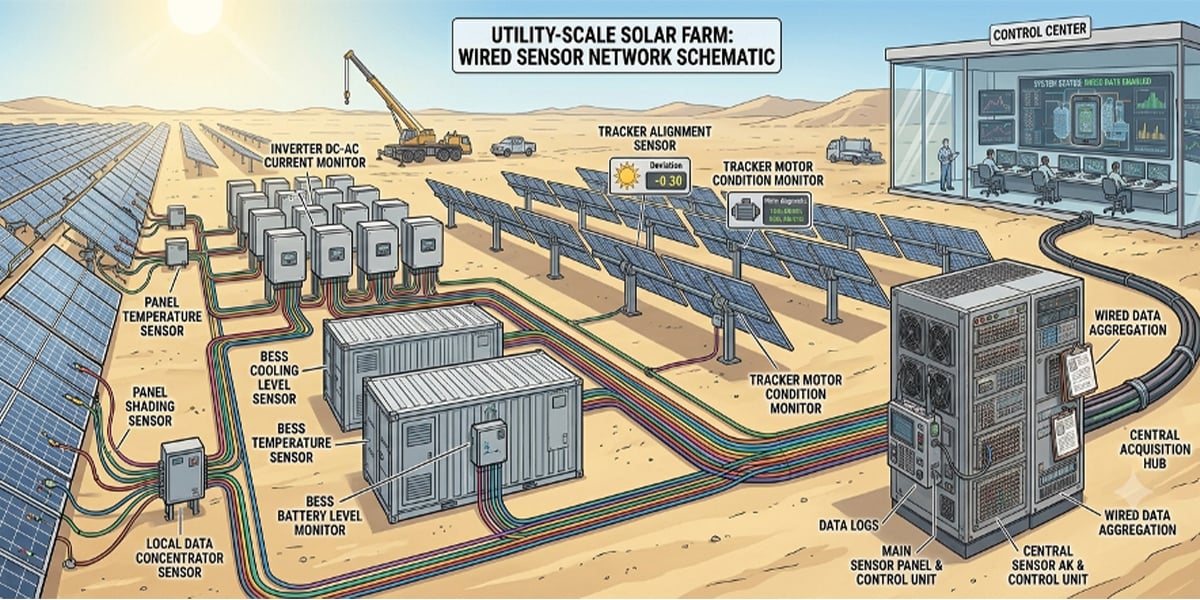
For most of the industry's history, these asset classes have been monitored in the crudest possible way: with wired connections such as RS485 or similar that require trenching, conduit and a maintenance crew willing to chase cable faults across hundreds of hectares. As solar farms scale up, utility projects now routinely exceed 500MW and span thousands of acres. The economics of wired monitoring no longer hold.
This blog is about the specific role that LoRa® technology, built by Semtech, plays in closing that intelligence gap — not as a generic Internet of Things (IoT) solution, but as a purpose-fit connectivity layer for the precise challenges that trackers, inverters and cleaning robots create.
## What Makes Inverter Monitoring So Difficult at Utility Scale?
There are three types of inverters in the solar renewable energy segment: string inverters, central inverters and microinverters. They all serve the same core function: DC-to-AC conversion, but each creates a distinct monitoring challenge.
Inverter efficiency degrades with heat. A string inverter running at 45°C converts measurably less power than the same unit at 25°C. Digital signal processor (DSP) faults, insulated-gate bipolar transistor (IGBT) wear and harmonic distortion are early-warning signs that can be caught by monitoring current and temperature profiles, but only if the data is actually reaching an analytics platform in real time. While wired architecture such as RS485 remains a viable approach when monitoring a small, fixed number of inverters, it does not scale economically or operationally to full-fleet coverage. At utility scale, running conduit to every inverter across hundreds of hectares requires significant upfront capital expenditure, and any expansion of the monitoring scope means additional trenching, cabling and commissioning work. Wireless connectivity, by contrast, allows original equipment manufacturers (OEMs) and asset owners to extend monitoring to every inverter on site with minimal additional infrastructure, turning exhaustive coverage from a capital project into a configuration change.
Semtech engineered [LoRa integrated circuits (ICs)](https://www.semtech.com/products/wireless-rf/end-nodes-ics) for the constraints that inverter OEMs face at product level: compact footprint, cost-optimized bill of materials (BOM) and radio frequency (RF) performance that holds up across thousands of field deployments. For a manufacturer embedding wireless connectivity into a device that ships millions of units, all three of those factors carry equal weight in the design decision.
Some companies have taken a retrofit approach to inverter monitoring, building plug-and-play devices that attach directly to existing photovoltaic storage equipment without any rewiring. One example is a data acquisition stick built on the LoRa Connect™ [SX1262](https://www.semtech.com/products/wireless-rf/lora-connect/sx1262), which slots into inverter infrastructure and immediately begins streaming real-time generation, voltage and current data to a cloud analytics platform. The device operates on a private LoRa network covering up to 100 nodes per gateway and bridges to cloud platforms via Message Queuing Telemetry Transport (MQTT), Modbus and Transmission Control Protocol/User Datagram Protocol (TCP/UDP).
## Why Is Solar Tracker Monitoring So Complex?
If inverters represent the electrical intelligence layer, trackers represent the mechanical intelligence layer of a solar farm. A solar tracker is a motorized mounting system that rotates panels to follow the sun across the sky. Single-axis trackers, the dominant design in utility installations, can boost energy yield by 10–25% compared to fixed-tilt systems. For example, at a 250MW farm, that difference can represent millions of dollars of annual revenue. But trackers are mechanical systems operating outdoors, continuously, and sometimes across extreme weather conditions. The failure modes are varied: actuator wear, motor faults, gearbox backlash, misalignment caused by uneven terrain settlement, and stow failures during high-wind events. A single tracker row that fails to auto-stow in time during a storm can suffer panel damage costing far more than the tracker itself.
The communication challenge is acute. A 250MW project may have 5,000–10,000 individual tracker rows, each needing to report its angle, motor status and fault codes. Those rows are distributed across terrain that is rarely flat and frequently remote. Cellular coverage in many solar-rich regions like rural India, the Middle East, Central Asia, or even in remote areas of North America and Europe can be unreliable or prohibitively expensive to guarantee at that node count.
[PV Hardware (PVH)](https://semtech.com/resources/customer-stories/pv-hardware-lorawan), a Spanish tracker OEM with over 650 projects worldwide, took a different architectural path — LoRaWAN® — to achieve a similar goal. PVH's system uses integrated anemometers that trigger simultaneous stow commands across all tracker rows via LoRaWAN when wind speeds cross a threshold. The critical requirement is reliability: every tracker must receive and execute the stow command before wind damage occurs. The link budget and obstacle penetration characteristics of LoRa have been the criteria for the wireless technology choice, while the ease of building and managing a private network has oriented the choice toward a public well proven standard protocol like LoRaWAN. PVH has deployed up to several hundreds of thousands of trackers operating on LoRaWAN worldwide, with cases where a single network is managing up to 40,000 devices.
## The Cleaning Robot Monitoring Gap
Cleaning robots are the newest of the three asset classes, and the one most often bolted onto a monitoring strategy as an afterthought. These autonomous or semi-autonomous units traverse rows of panels on rails or wheeled platforms, using brushes, air jets or water systems to remove the same dust and debris that erode energy yield between manual maintenance visits. On a large farm, a fleet of these robots can be the difference between panels that stay near peak output and panels that quietly lose several percentage points of production between cleaning cycles.
The monitoring problem here is different in character from inverters and trackers. A cleaning robot is mobile, so it cannot simply be wired into a fixed monitoring backbone the way an inverter or tracker controller can. It also runs on a battery between docking-station charges, so anything added to the platform must justify its power draw. And because a robot's job is to physically move across acres of panel rows, its connection to the network has to hold up continuously as it changes position, not just at a fixed point.
Operators need visibility into a specific set of signals: battery state of charge, current row and position, cleaning-cycle completion, and fault conditions such as a stalled brush motor or an obstruction on the rail. Missing any of these means a robot can sit idle mid-row for days before anyone notices, or return to its dock only partially charged for its next scheduled run.
This is where the same properties that make LoRa a fit for trackers and inverters apply just as directly to a moving platform. A robot only needs to stay in range of a single gateway covering the full site, not a dense mesh of short-range access points that would need to track its position. Low transmit current keeps the radio from competing with drive motors and cleaning mechanisms for battery budget. And because the same sub-GHz signal that penetrates metal racking and dense rows of panels also reaches a robot wherever it happens to be on the field, operators get continuous status updates without having to engineer connectivity around the robot's movement.
## Why Does LoRa Fit Solar Monitoring Better Than Other Wireless Options?
The tracker, inverter and cleaning robot use cases share a specific set of requirements that explain why LoRa has emerged as the preferred connectivity solution across multiple OEMs independently:
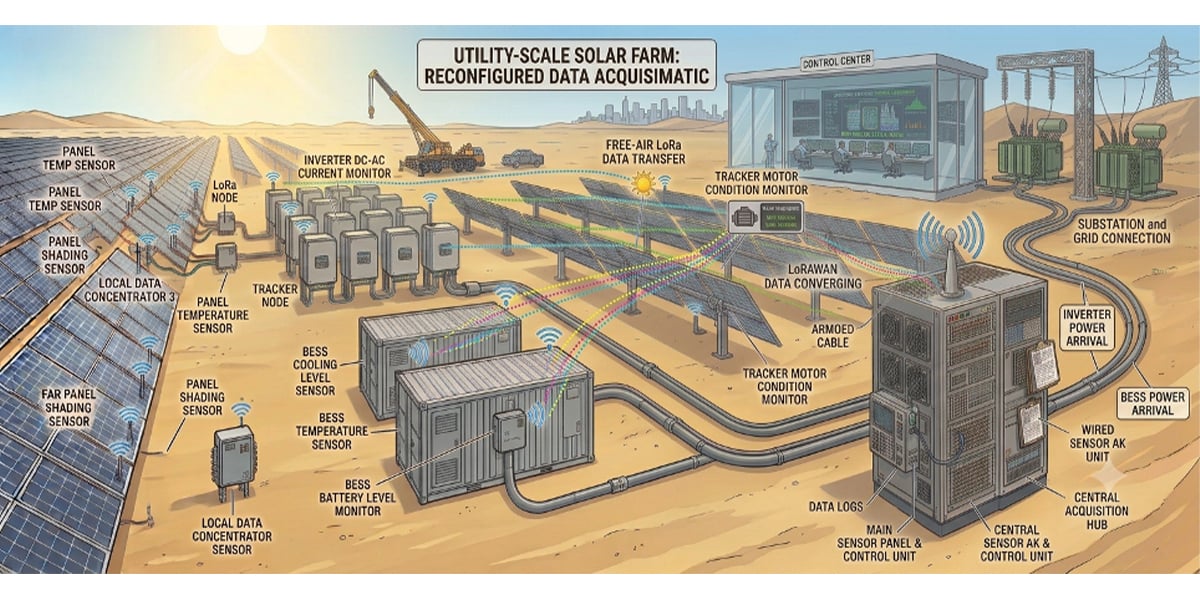
- **Long range with low infrastructure overhead:** A single LoRaWAN gateway can cover 2–15 km in open terrain, enough to serve an entire utility-scale farm from a single point. This is not achievable with Zigbee (10–100m per hop) or Wi-Fi (150m). For tracker control and cleaning robot dispatch, this means one gateway can maintain communication with every row simultaneously.
- **Sub-GHz propagation in complex environments:** Metal mounting structures, inverter cabinets and the panels themselves create a RF challenging environment. Sub-GHz LoRa benefits from a higher link budget and lower propagation losses compared to higher-frequency alternatives, providing substantial margin against path loss across cluttered, metallic outdoor sites.
- **Power flexibility across node types:** Tracker controllers and inverter monitoring nodes are typically powered from the equipment they monitor. Cleaning robots operate on onboard battery packs between docking station charges. In both cases, the low transmit current of Semtech's LoRa ICs keeps the wireless module from becoming a meaningful contributor to system power budgets, regardless of the host platform.
- **No recurring fees and no cellular dependency:** At 5,000–10,000 nodes per farm, cellular data costs become significant at scale. A private LoRa network, whether using a custom stack or LoRaWAN with a self-hosted network server, eliminates per-node recurring costs entirely. Equally important, solar farms are frequently located in rural and remote areas where cellular coverage cannot be guaranteed. A self-managed LoRa network removes that dependency entirely, giving operators full-fleet visibility regardless of local network infrastructure.
- **Regulatory flexibility:** Solar projects are global. Semtech's LoRa portfolio spans sub-GHz and 2.4GHz bands for regional compliance. The ability to leverage a single chip covering all relevant industrial, scientific and medical (ISM) bands gives OEMs a path to a single SKU across markets.
- **Proven ecosystem and fast time to market:** LoRaWAN is a mature, standardized protocol backed by the LoRa Alliance® and a global ecosystem of certified gateways, network servers and device manufacturers. OEMs building tracker controllers, inverter monitoring modules or cleaning robot coordination systems can source certified hardware, integrate pre-validated cloud connectors and deploy in a fraction of the time required by proprietary wireless approaches. For teams entering new geographies, the ecosystem also reduces certification risk and support overhead significantly. And for deployments that require longer range or more complex topologies, multiple mesh proposals built on LoRa are available, offering flexibility well beyond the standard LoRaWAN architecture.
## Where Is the Solar O&M Market Headed Next?
The solar operations and maintenance (O&M) market is projected to reach $9.48 billion by 2025 and continue growing as global installed capacity expands. Within that market, the shift from reactive to predictive maintenance is accelerating driven by asset owner pressure to reduce the levelized cost of energy (LCOE) across aging fleets.
Industry analysts including Wood Mackenzie and BloombergNEF have documented double-digit annual growth in utility-scale solar installations globally, with India, China, the Middle East, and the Americas representing the largest growth markets. India is a priority market specifically as the government's target of 500GW of renewable capacity by 2030 is creating demand for monitoring solutions at a scale that wired sensor infrastructure cannot economically serve.
## Key Takeaway: Wireless Monitoring Is No Longer Optional at Utility Scale
The shift from wired to wireless monitoring in solar farms is not a technology trend in search of a problem. It is a response to a real economic constraint. As farms scale, the cost of wired infrastructure becomes prohibitive, and the information gaps it creates become costly.
LoRa technology, and Semtech's portfolio of ICs spanning sensor nodes to gateway concentrators to cloud connectivity, provides the specific combination of range, power efficiency and regulatory flexibility that tracker, inverter and cleaning robot operations demand. The deployments are not hypothetical. Multiple OEMs have independently arrived at LoRa as the right answer for their specific product and market context. A significant factor in that convergence is the LoRaWAN ecosystem itself: the ability to set up a network quickly using certified, interoperable hardware, manage it through proven network server software, and scale it without recurring infrastructure costs has meaningfully lowered the barrier to deployment.
For OEMs building the next generation of tracker controllers, inverter monitoring platforms and cleaning robot coordination systems, the question is not whether to embed wireless connectivity. The question is which wireless technology fits the environment, the power budget and the geography, and an increasing body of field evidence points to LoRa.
To learn more about **LoRa technology** and Semtech’s comprehensive **IoT solutions**, visit [Semtech.com](https://www.semtech.com/) or explore the extensive resources available through the **LoRa Alliance**.
Stay informed on the latest advancements in LoRa by subscribing to the LoRa Monthly[Newsletter](https://info.semtech.com/e3t/Ctc/T6+113/chXTG04/VVsvB72ngQg-W34XGBm25vnsNW3_3yVc5zCgLSN1-yY0g3qgz0W8wLKSR6lZ3n-W2T_dfS4yPdkYW2tfMN_1v9h6wV6-2Lp5Pg3Q2W35Btbm45b2l5W34KKBp8kC53BW21z-zH34-NqwW4rVf-V5Hz497W5VcjRM8tYbc0W1-J-Pw3839SkW5_YY6V4ck9sYW4k55gK2yWG77VDKCv_7bDd9SN7KSVcXMPNfBW7xjxrR2RtJ2HW1hpB7D6tF0sPW5XlfYg2gqMqsW1_M8yS7tvn8lN9cQymzrPp7nW6-0bXh38lS9RW9kQ0qC8qGBSTW3cR56d7Ypv7wW1Vpxc42MNb-TW8d8M-d88rFwYN7Zw89JDkfsjVFjPbb5yc80DW37Hr3T2Qpyk_W7L_-gP3JJhJcW8M5QzG6KcDNYf1vPS2j04), and discover Semtech’s full range of [LoRa products](https://www.semtech.com/products/wireless-rf), [case studies](https://www.semtech.com/resources/customer-stories) and [technical resources](https://www.semtech.com/resources) to accelerate your next IoT innovation.
[](https://blog.semtech.com/hs/cta/wi/redirect?encryptedPayload=AVxigLJqkfxHgv%2FMC0Uctim6MaPi9C2wjT2NJyOLQIpF6DRbn3wgs0ennNr%2Fx61%2B7fLoeBU686PGMNmzsXK3mJ2bZhXORAeTjq4XJnsiSt783m3b6WGUR79TchswD9O%2BZXUU138uG6YZ4ekCiiOsBgbaPVXQLPvhS0BgA44%2Fh9NLrkdhglUqFoziW0ZygemM0KNzJ%2FhZ%2FWuZlMaCLQ%3D%3D&webInteractiveContentId=191181683275&portalId=2507363)
*Semtech®, the Semtech logo, LoRa®, and LoRaWAN® are registered trademarks or service marks, and LoRa Connect™ is a trademark or service mark, of Semtech Corporation or its subsidiaries. Other product or service names mentioned herein may be the trademarks of their respective owners.*
---
[LoRa](https://blog.semtech.com/topic/lora) [Smart Agriculture](https://blog.semtech.com/topic/smart-agriculture)
### Sign Up for Blog Updates
Get innovation delivered to your inbox. Sign up for our blog and stay on top of the very latest from Semtech.
### Related Blogs:
[LoRaWAN® Networks Now Available for AWS IoT Core](https://blog.semtech.com/lorawan-networks-now-available-for-aws-iot-core)
December 15, 2020
[The Future of 5G and LoRaWAN®: Friends or Foes?](https://blog.semtech.com/the-future-of-5g-and-lorawan-friends-or-foes)
February 9, 2021
[Helium’s Decentralized Approach to LoRa®-based Networks](https://blog.semtech.com/heliums-decentralized-approach-to-lora-based-networks)
March 5, 2020
[Semtech](https://blog.semtech.com/)
- [Sierra Wireless](https://www.sierrawireless.com/)
- [LoRa](https://www.semtech.com/lora)
- [Products](https://www.semtech.com/products)
- [Technology](https://www.semtech.com/technology)
- [Design Resources](https://www.semtech.com/design-support/product-guides)
- [About Semtech](https://www.semtech.com/company)
### Quick Links
- [Parametric Search](https://www.semtech.com/design-support/parametric-search)
- [mySemtech](https://semtech.my.site.com/DP/)
- [Blogs](https://blog.semtech.com/)
- [Careers](https://www.semtech.com/careers)
- [Contact Us](https://www.semtech.com/company/contact)
Semtech is a leading global supplier of high performance analog and mixed-signal semiconductors and advanced algorithms for infrastructure, high-end consumer and industrial equipment.
- [Facebook](https://www.facebook.com/semtechcorporation)
- [Twitter](https://twitter.com/SemtechCorp)
- [YouTube](https://www.youtube.com/user/SemtechMediacenter)
- [LinkedIn](https://www.linkedin.com/company/semtech/)
[Privacy Policy](https://www.semtech.com/legal) | [Terms & Conditions](https://www.semtech.com/terms) | [Supplier Responsibility](https://www.semtech.com/quality/policy) | [Statement Against Human Trafficking and Slavery](https://www.semtech.com/uploads/quality/semtech-statement-against-human-trafficking-and-slavery.pdf) | © 2025 All Rights Reserved
- [Home](https://www.semtech.com/)
- [LoRa](https://www.semtech.com/lora)
- [LoRa Overview](https://www.semtech.com/lora)
- [LoRa(PHY)](https://www.semtech.com/lora/what-is-lora)
- [Benefits of LoRa](https://www.semtech.com/lora/why-lora)
- [LoRaWAN® Standard](https://www.semtech.com/lora/lorawan-standard)
- [Applications](https://www.semtech.com/lora/lora-applications)
- [Ecosystem](https://www.semtech.com/lora/ecosystem)
- [Products](https://www.semtech.com/lora/lora-products)
- [Resources](https://www.semtech.com/lora/resources)
- [Products](https://www.semtech.com/products)
- [Products Overview](https://www.semtech.com/products)
- [Wireless RF](https://www.semtech.com/products/wireless-rf)
- [Circuit Protection](https://www.semtech.com/products/circuit-protection)
- [Signal Integrity](https://www.semtech.com/products/signal-integrity)
- [Professional AV](https://www.semtech.com/products/professional-av)
- [PerSe™ Smart Sensing](https://www.semtech.com/products/perse-smart-sensing)
- [Broadcast Video](https://www.semtech.com/products/broadcast-video)
- [Power Management](https://www.semtech.com/products/power-management)
- [High Reliability](https://www.semtech.com/products/high-reliability)
- [Technology](https://www.semtech.com/technology)
- [Technology Overview](https://www.semtech.com/technology)
- [LoRa Wireless RF for the IoT](https://blog.semtech.com/lora)
- [Tri-Edge™ PAM4 CDR](https://www.semtech.com/technology/tri-edge)
- [BlueRiver® PLATFORM FOR SDVoE™](https://www.semtech.com/technology/blueriver)
- [BlueRiver OVERVIEW](https://www.semtech.com/technology/blueriver)
- [BlueRiver APPLICATIONS](https://www.semtech.com/technology/blueriver-applications)
- [BlueRiver VERTICAL MARKETS](https://www.semtech.com/technology/blueriver-vertical-markets)
- [SDVoE ALLIANCE™](https://www.semtech.com/technology/blueriver-sdvoe)
- [Circuit Protection](https://www.semtech.com/technology/esd-protection)
- [Circuit Protection Overview](https://www.semtech.com/technology/esd-protection)
- [Z-Platform](https://www.semtech.com/technology/z-platform)
- [Design Resources](https://www.semtech.com/design-support)
- [Design Resources Overview](https://www.semtech.com/design-support)
- [Design Resources](https://www.semtech.com/design-support/product-guides)
- [Cross Reference Search](https://www.semtech.com/design-support/cross-reference-search)
- [Parametric Search](https://www.semtech.com/design-support/parametric-search)
- [mySemtech](https://semtech.force.com/DP)
- [Quality](https://www.semtech.com/quality)
- [Quality Overview](https://www.semtech.com/quality)
- [Reliability](https://www.semtech.com/quality/reliability)
- [Product Testing](https://www.semtech.com/quality/testing)
- [Material & Packaging Declarations](https://www.semtech.com/quality/declarations)
- [Quality & Failure Analysis](https://www.semtech.com/quality/analysis)
- [Search Pb(Lead)-Free/RoHS-Green](https://www.semtech.com/quality/search-pb-lead-free-rohs-green)
- [Environmental Initiatives](https://www.semtech.com/quality/environment)
- [Quality Policy](https://www.semtech.com/quality/policy)
- [Quality Certifications](https://www.semtech.com/quality/certifications)
- [IR Reflow Profiles](https://www.semtech.com/quality/reflow-profiles)
- [About](https://www.semtech.com/company)
- [Leadership](https://www.semtech.com/company/executive-leadership)
- [Corporate Citizenship (ESG)](https://www.semtech.com/company/corporate-citizenship)
- [Core Values](https://www.semtech.com/company/core-values)
- [News & Media](https://www.semtech.com/company/news-and-media)
- [Events](https://www.semtech.com/company/events)
- [Careers](https://www.semtech.com/careers)
- [Locations](https://www.semtech.com/company/locations/north-america)
- [Security](https://www.semtech.com/company/security)
- [Contact](https://www.semtech.com/company/contact)
- More
- [Parametric Search](https://www.semtech.com/design-support/parametric-search)
- [Shop](https://www.semtech.com/shop)
- [Investors](http://investors.semtech.com/)
- [Blog](https://www.semtech.com/blog)
- [mySemtech](https://semtech.force.com/DP)
- [Contact](https://www.semtech.com/company/contact)
```json
{
"@context" : "https://schema.org",
"@type" : "BlogPosting",
"author" : {
"@type" : "Person",
"name" : "Swaroop Chitturi",
"url" : "https://blog.semtech.com/author/swaroop-chitturi"
},
"dateModified" : "2026-08-25T22:37:28.733Z",
"datePublished" : "2026-08-25T22:37:28.000Z",
"headline" : "Closing the Solar Farm Monitoring Gap with LoRa® Technology",
"image" : [ "https://blog.semtech.com/hubfs/LoRa-BLOG-Closing%20the%20Solar%20Farm%20Monitoring%20Gap-Banner-1400x600-1.jpg" ],
"mainEntityOfPage" : {
"@id" : "https://blog.semtech.com/closing-the-solar-farm-monitoring-gap-with-lora-technology-1",
"@type" : "WebPage"
},
"publisher" : {
"@type" : "Organization",
"logo" : {
"@type" : "ImageObject",
"url" : "https://blog.semtech.com/hubfs/Imported%20sitepage%20images/semtech-logo.svg"
},
"name" : "Semtech"
}
}
```
```json
{
"@context": "http://schema.org",
"@type": "BlogPosting",
"mainEntityOfPage": {
"@type": "WebPage",
"@id": "https://blog.semtech.com/closing-the-solar-farm-monitoring-gap-with-lora-technology-1"
},
"headline": "Closing the Solar Farm Monitoring Gap with LoRa® Technology",
"image": {
"@type": "ImageObject",
"url": "https://info.semtech.com/hubfs/LoRa-BLOG-Closing%20the%20Solar%20Farm%20Monitoring%20Gap-Banner-1400x600-1.jpg"
},
"datePublished": "2026-08-25 22:37:28",
"dateModified": "August 25, 2026, 10:37:28 PM",
"author": {
"@type": "Person",
"name": "Swaroop Chitturi"
},
"publisher": {
"@type": "Organization",
"name": "Semtech Corporation",
"logo": {
"@type": "ImageObject",
"url": "https://info.semtech.com/hubfs/Imported%20sitepage%20images/semtech-logo.svg"
}
},
"description": "Wired sensors can't scale past 500MW. Learn how LoRa solar farm monitoring gives OEMs full-fleet visibility into trackers, inverters and cleaning robots."
}
```